


 ES
ES 




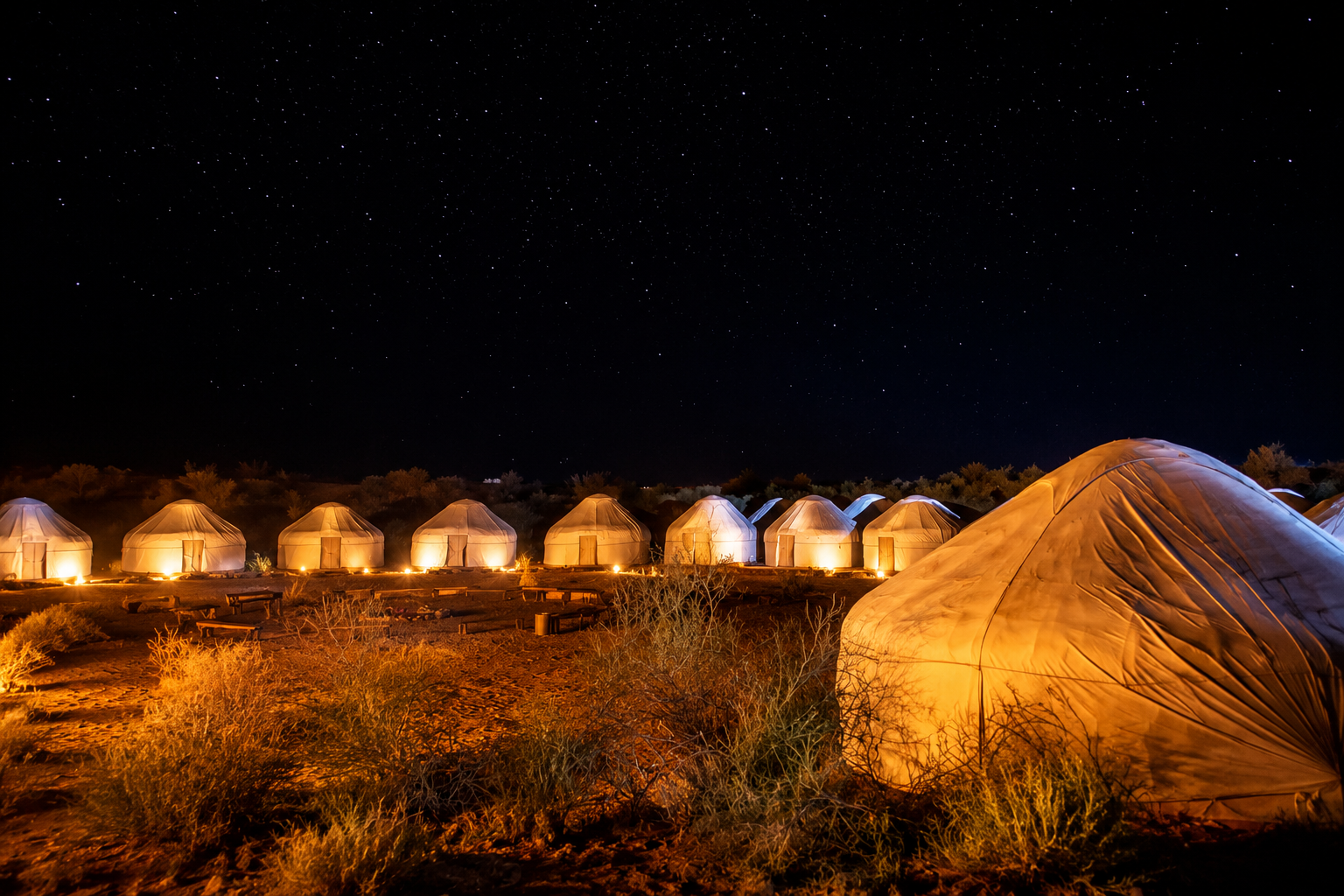
Why Traditional Yurts Are Still the Perfect Nomadic Home
Discover why traditional yurts have remained the perfect nomadic home for centuries, combining smart design, natural comfort, and timeless engineering.
Why Traditional Yurts Are Still the Perfect Nomadic Home
Imagine waking up in the heart of the Kyzylkum Desert as the first rays of sunlight gently illuminate the endless sand dunes. There are no concrete walls, no traffic noise, and no towering buildings—only fresh air, the distant sound of birds, and the peaceful silence of nature. Yet despite being surrounded by one of Central Asia's most challenging landscapes, you spent the night in complete comfort.
This isn't a modern luxury cabin or a high-tech eco-house. It's a traditional yurt—a remarkable home that has sheltered nomadic families across Central Asia for thousands of years.
At first glance, a yurt may appear to be nothing more than a simple round tent. However, behind its modest appearance lies centuries of practical knowledge, brilliant engineering, and an extraordinary understanding of nature. Long before architects spoke about sustainable design or energy-efficient buildings, nomadic communities had already created one of the world's smartest portable homes.
So, what makes a traditional yurt the perfect nomadic home even today?
Built to Move, Built to Last
Unlike permanent houses, nomadic families followed seasonal pastures in search of fresh grazing land for their livestock. Their homes needed to travel with them.
The yurt solved this challenge perfectly.
Every part of the structure can be dismantled, transported, and reassembled within just a few hours. The wooden lattice walls fold neatly together, the roof poles are lightweight yet incredibly strong, and the felt covering can be rolled up for easy transport.
Despite its portability, a properly built yurt is surprisingly durable. Many traditional yurts withstand years of constant use while enduring harsh weather conditions that would damage ordinary tents.
Why Is Every Yurt Round?
One of the first things travelers notice is the yurt's distinctive circular shape.
This is far more than a design choice.
Strong desert winds flow smoothly around a round structure instead of pushing directly against flat walls. As a result, the yurt experiences less pressure during storms and remains remarkably stable.
The circular design also distributes weight evenly across the wooden frame, allowing the structure to support its roof without heavy beams or complex foundations.
It's a simple idea that has proven incredibly effective for centuries.
Natural Climate Control Without Electricity
Modern homes rely on heating systems, air conditioners, and insulation to stay comfortable.
Traditional yurts achieve much of the same comfort naturally.
Their thick felt covering—traditionally made from sheep's wool—acts as excellent insulation. During hot summer days, it helps keep the interior cool by reducing heat from the sun. When temperatures drop at night or during winter, the same felt traps warmth inside the yurt.
The materials also allow the structure to breathe, helping regulate humidity and create a comfortable indoor environment.
This natural climate control explains why many visitors are surprised by how pleasant a yurt feels, even in the middle of the desert.
A Home Designed Around Nature
Everything about a traditional yurt reflects a deep understanding of the natural environment.
The entrance is often positioned to avoid prevailing winds. The central roof opening provides natural light during the day while allowing smoke and warm air to escape. Fresh air circulates continuously, creating a healthier living space without mechanical ventilation.
Nothing about the design is accidental.
Every element has been refined over generations through practical experience rather than modern technology.
Strong Without Nails
Perhaps one of the most fascinating aspects of a traditional yurt is that its structure requires very few metal fasteners.
Instead, wooden components fit together using carefully crafted joints, leather straps, and strong woven ropes.
This flexible construction allows the yurt to move slightly during strong winds instead of resisting every force rigidly. Rather than becoming weaker, this flexibility actually improves its durability.
It is an elegant engineering solution that has stood the test of time.
The Perfect Balance Between Comfort and Simplicity
Step inside a traditional yurt, and you'll quickly notice how welcoming the space feels.
The circular interior encourages conversation and togetherness. Natural materials create a warm atmosphere, while handcrafted carpets and colorful decorations reflect generations of cultural tradition.
Although the design is simple, it provides everything needed for comfortable living.
For many modern travelers, spending a night in a yurt becomes an opportunity to disconnect from busy schedules and reconnect with nature.
Why Modern Architects Still Admire Yurts
Today, architects and designers around the world study traditional yurts as examples of sustainable architecture.
The principles are surprisingly modern:
- Efficient use of materials
- Minimal environmental impact
- Excellent natural insulation
- Portable construction
- Long-lasting durability
Many eco-homes and tiny house projects now incorporate ideas that nomadic communities perfected centuries ago.
The yurt proves that innovation doesn't always require new technology. Sometimes, the best solutions have already existed for generations.
Experience the Timeless Comfort of a Traditional Yurt
Staying in a traditional yurt is about much more than spending a night in the desert.
It is an opportunity to experience one of Central Asia's greatest inventions—a home shaped by nature, refined through centuries of nomadic life, and admired for its remarkable engineering.
Whether you're watching the sunset over the Kyzylkum Desert, sharing stories around a campfire, or falling asleep beneath a sky filled with countless stars, you'll soon understand why traditional yurts continue to inspire travelers from around the world.
Some homes are built with concrete and steel.
Others are built with centuries of wisdom.